Practicing a new and challenging activity is a good bet for building and maintaining cognitive skills.
https://www.health.harvard.edu/mind-and-mood/train-your-brain

https://www.health.harvard.edu/mind-and-mood/train-your-brain

For people with dementia, creative activities, such as painting, playing and instrument or knitting can provide not only a sense of accomplishment, but also a way to challenge different areas of the brain, enhance cognitive function, exercise motor functions such as manual dexterity, and experience the reward and comfort of emotional connection.
Creative activities in combination with reminiscence activities, show dementia patients that their story is of value and interest to others. Most importantly, it also demonstrates to them that they are capable of adding beauty to the world for others to enjoy.
In a 2012 study, researchers found that older people who FELT LONELY were 64% more likely to develop dementia. This same increase in risk was not found in older people who were happily reclusive, indicating that it was ‘FEELING ALONE’ rather than ‘BEING ALONE’ that increased the risk.


Researchers have found that a specific type of brain training lowered dementia risk in healthy older adults by up to 29% [1]. The training, called “speed-of-processing,” is designed to improve the speed and accuracy of a person’s visual attention.
The findings come from a large, 10-year randomized controlled clinical trial called Advanced Cognitive Training for Independent and Vital Elderly (ACTIVE) [2]. The ACTIVE study was designed to test the effects of different cognitive training programs on the incidence of cognitive decline and dementia. Over 2,800 healthy older adults (average age 73.6 years) were randomly assigned to one of three brain-training groups—in-person training on verbal memory skills, in-person training on reasoning and problem-solving, or computer-based speed-of-processing training on visual attention—or to a control group that received no cognitive training. Participants in the training groups completed ten 60–75 minute training sessions over 5-6 weeks, and some participants received “booster” sessions (up to 4 hours of additional training after 1 and 3 years). The participants completed follow-up tests of cognition and function after 1, 2, 3, 5, and 10 years.
After 10 years, people assigned to the speed-of-processing training had a 29 percent lower incidence of dementia than people receiving no training. People who completed the “booster” sessions had an even greater reduction. For each additional booster training session, there was a 10% lower risk for dementia. When an effect is greater with more treatment—commonly referred to as a “dose-response relationship”—there is more confidence that the treatment is responsible. In contrast, the study found that people in the memory training and reasoning training groups did not have a significant reduction in dementia risk.
Further studies are needed to investigate why speed-of-processing training was protective while other types of brain training were not. In speed-of-processing training, the participant identifies an object (e.g., a truck) at the center of a computer screen while at the same time identifying a target in the periphery (e.g., a road sign). As the participant gets more answers correct, the test becomes more challenging with shorter presentation of increasingly similar objects. This type of brain training is available online as an exercise called “Double Decision” in BrainHQ [3].
The results will need to be replicated so we can be certain that the effects on dementia prevention are consistent and reliable. More training conferred greater protection in the ACTIVE trial, but we don’t yet know the optimal amount of training for dementia prevention. We also don’t know if this type of training is protective in people who already have impaired cognition or if it will protect younger people from cognitive decline and dementia many decades later. Researchers of the ACTIVE trial speculated that speed-of-processing training may lower dementia risk by improving the capacity or efficiency of the brain, or by promoting the health of brain tissue [1]. Brain imaging and other types of studies could help clarify the mechanisms underlying the protective effects of speed-of-processing training. Still, these findings are exciting and suggest for the first time that brain training can reduce dementia risk.
https://www.alzdiscovery.org/cognitive-vitality/blog/brain-training-can-reduce-dementia-risk
Why not?!
https://www.caretalk.co.uk/how-football-reminiscence-work-can-help-and-engage-people-living-with-dementia/
Mentally stimulating tasks create more brain cells and connections among cells. Having more brain cells, or cognitive reserves, enables us to withstand the challenges of age, notes a study in the June 2003 issue of the “British Medical Journal.” Leisure activities such as playing board games, reading, crossword puzzles, knitting and playing an instrument all stimulate learning in the brain and may reduce the risk of dementia.
Why is mental exercise so important?Just as the body needs physical exercise to keep fit, the brain needs mental exercise to stay active and alive. Mental exercise stimulates the brain, often providing long-lasting positive effects regarding thinking and reasoning skills, memory and processing speed.
There are a number of people that never show any signs of an age-related decline in cognitive functions. However, there is a greater number older people that do experience a loss of cognitive skills and abilities to varying degrees. For most of them the decline is part of the aging process caused by the death of brain cells. For others, dementia is the result of an illness or disease such as Alzheimer´s Disease, Multiple Sclerosis or Huntington’s Disease.
What are Cognitive Skills?
Cognition or cognitive skills refers to mental abilities including memory, attention, language, perception, and problem solving. Cognitive functions enable us to learn and remember, to concentrate, to communicate, to understand the world, carry out everyday actions and solve problems.
Cognitive impairment can range from mild to severe. With mild impairment, individuals may begin to notice changes in their mental abilities (e.g difficulty remembering a conversation, concentrating on a book, word finding problems, difficulties cooking, using money), but still be able to complete everyday activities. Severe impairment can lead to losing the ability to remember things, to recognise people, places or objects, to talk or write, and to carry out basic actions, resulting in the inability to live independently.
Great Activities That Strengthen Cognitive Skills
There are many types of activities that help to maintain and improve the cognitive skills. Some of them involve everyday activities like reading newspaper, writing letters, looking up information on internet, others are mind-challenging activities like playing board games, making crafts and solving puzzles.
Everyday Activities
One of the most important cognitive activities is engaging and meaningful conversation. Often as people age, they withdraw from social interaction, getting fewer opportunities to talk to others about things that are important to them. By asking their opinions and advice on situations, current affairs and events, their minds are stimulated and they experience a feeling of self-worth.
Reading involves language and cognition that exercises the brain. A study at the Mayo Clinic found that middle-aged people who read books or magazines are less likely to develop memory loss. Reading is a great cognitive exercise and can help prevent future memory loss.
Slightly changing an everyday routine is another way to enhance cognitive skills. Examples include using the opposite hand to hold the toothbrush when brushing your teeth, writing your name or dialing a telephone.
Hobbies and Crafts
Learning a new hobby or taking up a craft are excellent ways for (not only) elderly individuals to keep their brains active and alert. These activities stimulate the brain cells and often provide interaction with others. Finding something that interests the person provides them with enjoyment and a sense of positive self-esteem. Many of these activities also help the elderly to maintain eye and hand coordination and fine motor skills. These activities engage and stimulate the brain even more by sending it electrical impulses that signal pleasure from the activity. If the person has a physical limitation such as a shortened attention span, arthritis or poor eye-to-hand coordination, a craft or hobby can be modified in ways so they can still enjoy being part of things that make them happy (e.g. using bright colours and thicker crochet hook when crocheting).
The following are examples of crafts and hobbies that are usually well enjoyed: drawing, painting, knitting, playing music, scrapbooking, woodworking, making mosaics using tiles or colored paper, photographing
Games and Puzzles
Playing games and solving puzzles are excellent cognitive activities for everybody. These activities, demand working memory and reasoning skills. Dominoes, checkers, chess, card games, scrabble, bingo, jigsaw puzzles, crossword, word search, sudoku come in different levels and are great fun too!
Findings of current research suggest that supportive care for older adults should incorporate activities that stimulate their cognitive skills. These together with physical activities, social engagement, and nutrition support successful cognitive aging. Cognitive interventions support older adults in maintaining self-care as well as cognitive performance into advanced ages.

Mayo Clinic researchers have found that engaging in mentally stimulating activities, even late in life, may protect against new-onset mild cognitive impairment, which is the intermediate stage between normal cognitive aging and dementia. The study found that cognitively normal people 70 or older who engaged in computer use, craft activities, social activities and playing games had a decreased risk of developing mild cognitive impairment. The results are published in the Jan. 30 edition of JAMA Neurology.
Researchers followed 1,929 cognitively normal participants of the population-based Mayo Clinic Study of Aging in Olmsted County, Minn., for an average duration of four years. After adjusting for sex, age and educational level, researchers discovered that the risk of new-onset mild cognitive impairment decreased by 30 percent with computer use, 28 percent with craft activities, 23 percent with social activities, and 22 percent with playing games.
“Our team found that persons who performed these activities at least one to two times per week had less cognitive decline than those who engaged in the same activities only two to three times per month or less,” says Yonas Geda, M.D., psychiatrist and behavioral neurologist at Mayo Clinic’s Arizona campus and senior author of the study.
Researchers conducted a neurocognitive assessment at the time of enrollment in the study, with evaluations every 15 months. Following the assessment, an expert consensus panel at the Alzheimer Disease Research Center at Mayo Clinic made the classification of normal cognition or mild cognitive impairment for each study participant, based on published criteria.
“Our previous cross-sectional study had found an association between engagement in mentally stimulating activities in late life and decreased odds of mild cognitive impairment,” says Dr. Geda. “However, those findings were considered preliminary until confirmed by a prospective cohort study that we are now reporting in JAMA Neurology.”
The benefits of being cognitively engaged even were seen among apolipoprotein E (APOE) ?4 carriers. APOE ?4 is a genetic risk factor for mild cognitive impairment and Alzheimer’s dementia. However, for APOE ?4 carriers, only computer use and social activities were associated with a decreased risk of mild cognitive impairment.
“Even for a person who is at genetic risk for cognitive decline, engaging in some activities was beneficial,” says Janina Krell-Roesch, Ph.D., the first author of the study and a postdoctoral researcher in Dr. Geda’s Translational Neuroscience and Aging Program (TAP). “So I think the signal is there even for APOE ?4 carriers.”
Mayo Clinic. (2017, January 30). Mental activities may protect against mild cognitive impairment. ScienceDaily. Retrieved January 30, 2018 from www.sciencedaily.com/releases/2017/01/170130133315.htm

Every brain changes with age, and mental function changes along with it. Mental decline is common, and it’s one of the most feared consequences of aging. But cognitive impairment is not inevitable. Here are 10 ways how you can help maintain brain function.
Many research have been done during last years and they keep showing that brainy activities stimulate new connections between nerve cells. They may even help the brain generate new cells and build up a functional reserve that provides a hedge against future cell loss.
Any mentally stimulating activity should help to build up your brain. Do not stick with one only – practise as wide variety as possoble – read books, take courses, challenge yourself with brain teasers, do word puzzles, math problems, sudoku, wordsearch, quizes, etc. Experiment with things that require manual dexterity as well as mental effort, such as drawing, painting, knitting, making origami and many other.
Research shows that using your muscles also helps your mind. Regular exercise leads to increase of the number of tiny blood vessels that bring oxygen-rich blood to our brain. Exercise also spurs the development of new nerve cells and increases the connections between brain cells. This results in brains that are more efficient, plastic, and adaptive. Exercise also lowers blood pressure, improves cholesterol levels, helps blood sugar balance and reduces mental stress, all of which can help your brain as well as your heart.
Good nutrition can help your mind as well as your body. For example, people that eat a Mediterranean style diet that emphasizes fruits, vegetables, fish, nuts, unsaturated oils (olive oil) and plant sources of proteins are less likely to develop cognitive impairment and dementia.
Excessive drinking is a major risk factor for dementia. If you choose to drink, limit yourself to two drinks a day.
High blood pressure in midlife increases the risk of cognitive decline in old age. Stay lean, exercise regularly, limit your alcohol intake, reduce stress, and eat right. Use lifestyle modification to keep your pressure as low as possible.
Diabetes is an important risk factor for dementia. You can help prevent diabetes by eating right, exercising regularly, and staying lean. But if your blood sugar stays high, you’ll need medication to achieve good control.
High levels of LDL (“bad”) cholesterol are associated with an increased the risk of dementia. Diet, exercise, weight control, and avoiding tobacco will go a long way toward improving your cholesterol levels. But if you need more help, speak to your GP about medication.
People who are anxious, depressed, sleep-deprived, or exhausted tend to score poorly on cognitive function tests. Poor scores don’t necessarily predict an increased risk of cognitive decline in old age, but good mental health and restful sleep are certainly important goals.
Strong social ties have been associated with a lower risk of dementia, as well as lower blood pressure and longer life expectancy. Results from longitudinal studies suggest that degree of social engagement, marriage, living with someone and avoiding loneliness may have a protective effect on developing dementia.
Moderate to severe head injuries, even without diagnosed concussions, increase the risk of cognitive impairment. Avoid any possible falls and always wear a helmet made for the sport you’re playing.
It does not sound so complicated, does it? Give it a try and see how you feel.
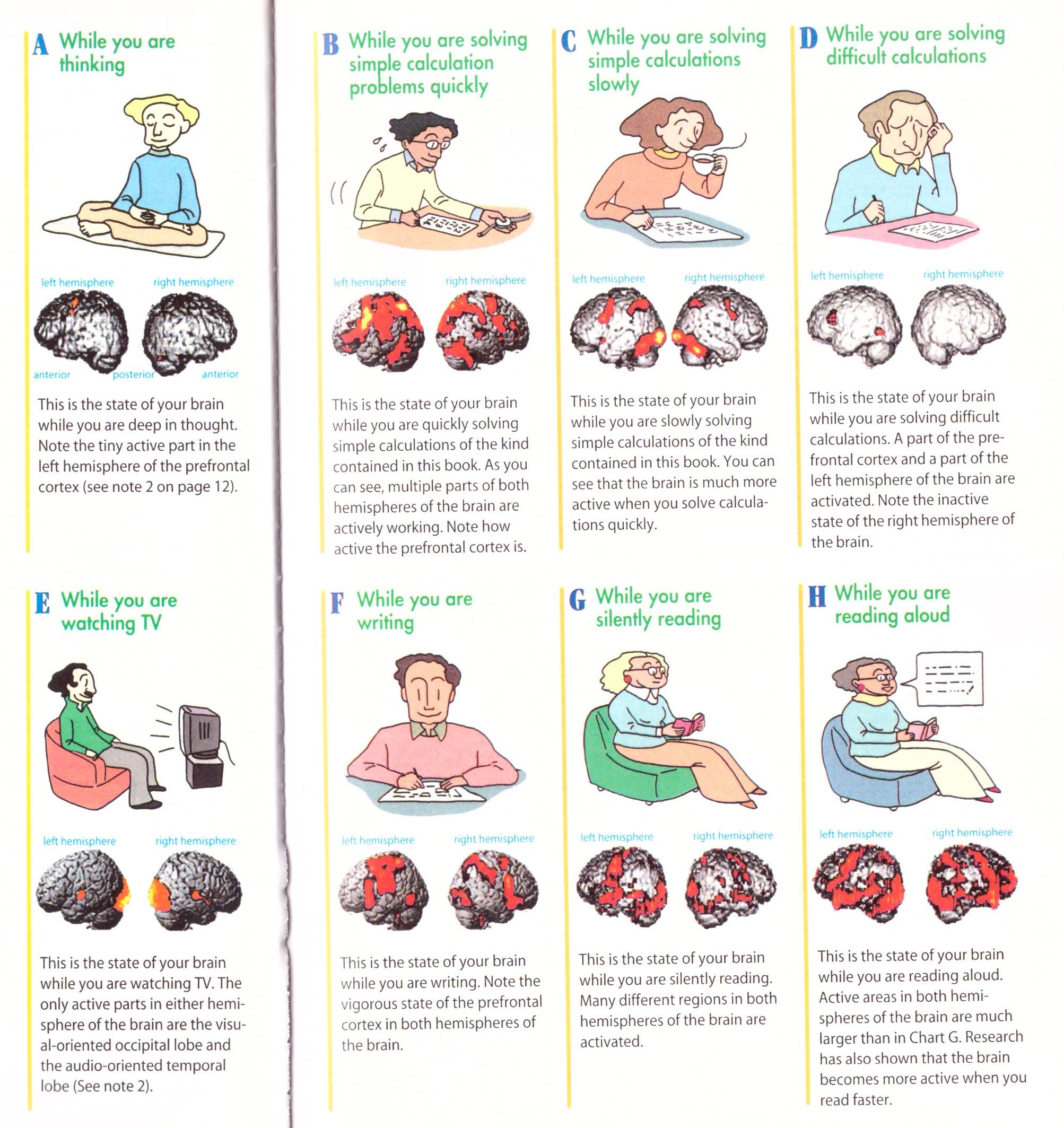
…that calculation and oral reading exercises are the optimal training methods according the latest brain research?
Have a look at at pictures – they show images of the brain taken by a brain-imaging device during various activities. The red colour on the images indicates an increase in regional cerebral blood flow, while the yellow colour indicates a larger increase in blood flow to areas where brain acitivity is most vigorous.
While you are just watching television, most of the different parts of the brain are barely functioning. These pictures show that solving simple calculations quickly is the most effective way of activating your brain. (Dr Kawashima, Train Your Brain, 2008)
Memory problems are very common cognitive deficits in brain injuries, strokes and dementia. Unfortunately, “fixing” cognitive impairments by cognitive training is not always posible. In order to help patients with their everyday activities and to increase their quality of life, number of external aids is available and should be brought to patients and their families attention.
In general, external aids are easy to use, accurate, and dependable. In particular, external aids are preferred for reminding oneself to do things.
Low tech aids include pencil/paper systems and simple organization tools:
High tech aids include electronic devices that have a range of programming options and uses, e.g. digital voice recorder, programmable watch, PDA (personal digital assistant, Smartphone, etc.
Effective use of memory aids requires good habits. It’s no good remembering to make a note in your diary if you don’t remember to look in it.
Remember, using external memory aids is not cheating. Don´t assume that because something is important to you, you will automatically remember it!